
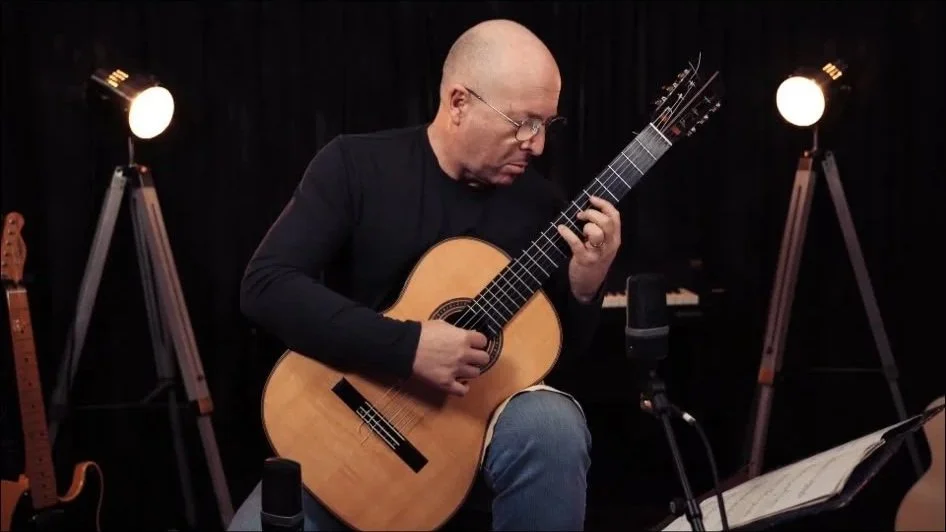
#Why Music Matters: An Interview with Iain George (Retired Headteacher, passionate advocate for music, professional guitarist living in Jersey).
Tell us a little about yourself and how your relationship with music began.
I started seriously studying music from about the age of 13, and I started working harder on the guitar. It coincided with moving to Jersey and being inspired by the good guitar scene here.
The Lord of Jersey, as he was known then, turned his big barn into a concert venue and used to host guitar festivals with some seriously good players. It was at one of these events that someone suggested I contact Angelo Gilardino in Italy and consider participating in his summer schools. So I did!
I regularly spent four weeks at summer school in Italy, learning from all of the amazing musicians that used to be there. It was fantastic to listen to, watch and be inspired by a whole variety of guitarists and, of course, Angelo himself.
Sometimes just being part of the audience for these players was incredible. I learned so much. It was one of the best times of my life!
What happened next in your musical journey?
I went on to Dartington College of Arts to study a one-year music A-level course. This led me to the RNCM and Guildhall School of Music to complete a degree in music.
It was interesting because the way I had been learning guitar at the Italian summer school compared to the way we learnt at these music establishments were almost polar opposites. I felt a bit of a conflict between learning techniques and learning how to feel and communicate music as a performer.
You started out on a path as a professional musician, so how did you end up becoming a headteacher in schools?
I formed a guitar quartet in the 90s which I toured with, and we had a lot of success performing and several sell-out concerts. It was great and I loved it. But when I was 22, I had had my son, and being a musician wasn’t particularly conducive to being a good dad and being able to be present for my family.
I was teaching guitar and was rushing around with students in several schools for very little money, and I decided to complete my PGCE to enable me to be a teacher in primary schools, with the hope that this would give me more options and stability.
I realised I actually quite enjoyed being a teacher. I found that my background as a musician enabled me to relate to and understand how kids learn - reading, maths, etc. I found I was good at teaching and I really loved working with young people.
This became my new journey.
How did your experience as a musician influence the way you approached teaching?
Teaching gave me the perspective that music should be accessible.
We might not find the next Beethoven, Bach or Beatle, but we definitely won’t if we don’t even try. Do you think Beethoven just magically became good? Of course not, his circumstances and support enabled that.
In teaching, we have a responsibility to make things accessible, to cast the net wide. To create circumstances where children can thrive and aspire to greatness in whatever it is they love. Music is an innate part of our physiology; everybody grows up with some sort of exposure to music. Parents sing to you, the radio plays in the background, you listen to bands that you like - music just is a part of life. We’re wired to love music. This has been a huge part of why I think music is so important for young people!
What is it about the guitar that has stayed with you for so long?
Classical guitar is one of the most perfect instruments. It creates wonderful sounds and some of the greatest composers have written music for guitar.
I love playing Bach, for example. It’s an incredible feeling when someone says, “What’s that?” and I can respond, “Oh, you know, I’m playing Johann.” I’m always amazed that I can access the music of true genius even if I have to work really hard to play it. It just transports you to another realm.
After more than 30 years of teaching, what does retirement mean for you musically?
Teaching was always supposed to be temporary, so now that I’m retired, I am able to work on my performing again. After teaching for 30-plus years, I retired quite recently and I was able to focus on my love of playing the guitar.
Musically, I am quite different from how I was 30 years ago, and you know what... I prefer who I am now.
Now I’ve found myself occasionally worrying about my technique or being insecure about my playing. But I am able to switch it off and think it’s more important to simply stop worrying about technique and just enjoy music.
That’s what it’s all about at the end of the day – you should enjoy what you do.
Why do you think it is so important that children have access to music?
Ken Robinson in Liverpool tells a story about interviewing Paul McCartney of the Beatles and asking if his music teacher spotted his talent. The answer was no. George Harrison was in the year below and his talent wasn’t spotted either.
Imagine being the music teacher that didn’t find the Beatles!?
I think that’s why it’s important to make music accessible, to cast the net wide and give everyone a chance.
That’s why Music in Action is incredible - they really try and live by this idea that music is for everyone.
They find new ways to make music, to bring music to the people and ensure that it’s happening in the schools, with young people who are excited to have the opportunity for more music making.
What does music give you personally?
Music feeds me intellectually. It helps me understand self-improvement and it just is a part of what I do. It’s not something separate from my life; it’s inherent to who I am and how I experience the world.