
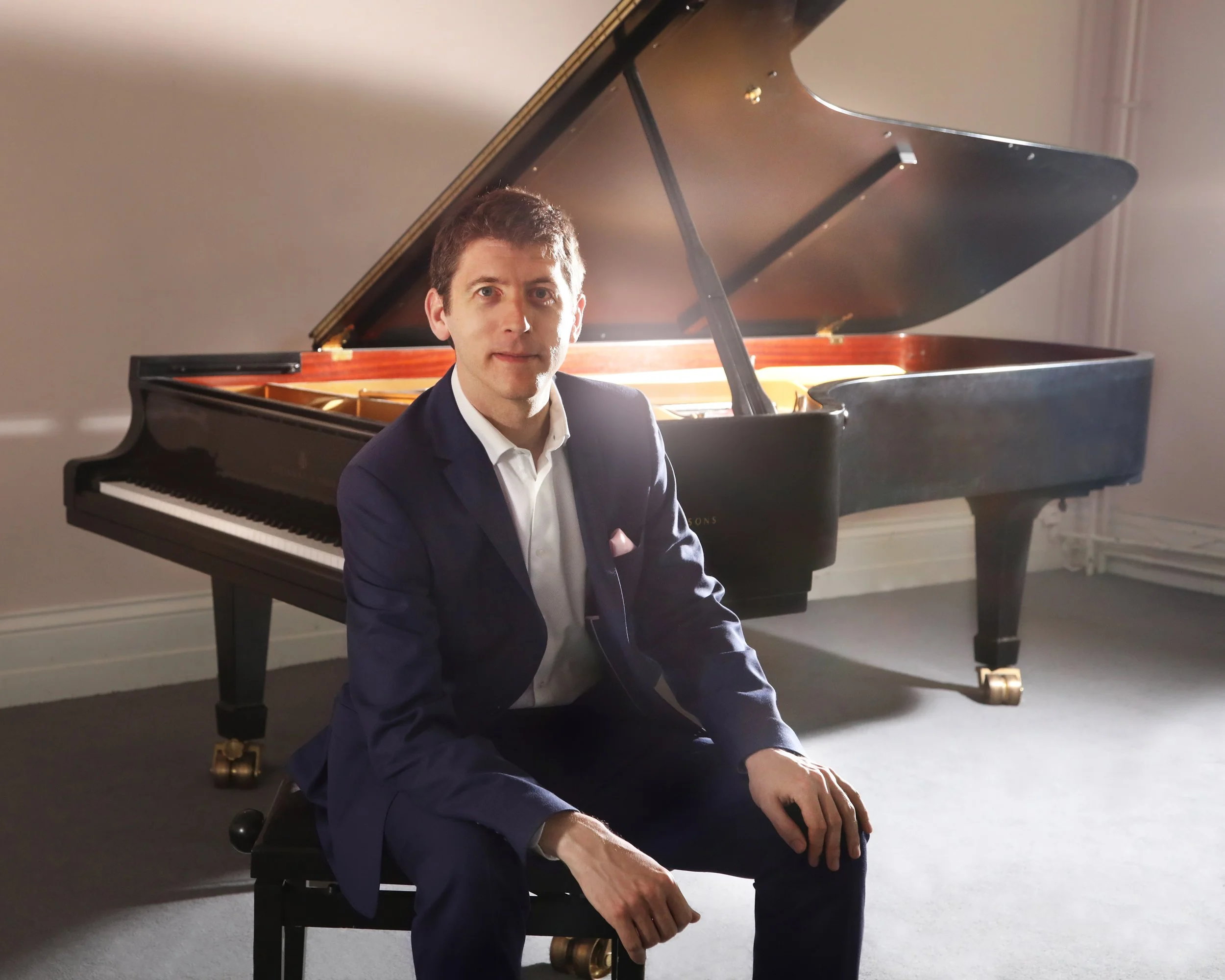
One of Ireland's most successful musicians, Finghin Collins was born in Dublin in 1977 and, following initial lessons with his sister Mary, studied piano at the Royal Irish Academy of Music with John O'Conor and at the Geneva Conservatoire with Dominique Merlet. Winner of multiple awards in his native Ireland, he went on to take first prize at the Clara Haskil Competition in Switzerland in 1999. Since then he has continued to enjoy a flourishing international career that takes him all over Europe and the United States, as well to the Far East and Australia.
Finghin is performing at this year’s Liberation International Music Festival with internationally renowned stars for an evening of “romantic fire” with Brahms, Haydn’s fiery Gypsy melodies, and a Paganini showpiece. We sat down with him to find out why music matters to him.
“Romantic Fire”, taking place on 15 May, brings together chamber music from Haydn to Mendelssohn. How do you think this kind of programming helps audiences connect emotionally with classical music?
This programme includes music that is immediately attractive and approachable, if not already well-known to a wide audience. Haydn’s Gypsy Trio is full of humour and catchy tunes, while Mendelssohn’s astonishing D minor trio is bursting with energy and lyricism. As the pianist in the trio, I have to play the vast majority of the notes, but that goes with the terrain, I suppose! The Brahms Sonata in G major is one of that composer’s most attractive works (and that is saying a lot!), with luscious melodies that linger long in the memory and a wistful nostalgia throughout. Emotions run deep in the music, and most listeners will feel a connection immediately. The Paganini work for cello and piano is frothy and sparkling, pure entertainment.
What role do you believe music plays in bringing people together across different cultures and generations?
Music is the most universal and international language all of its own; it breaks all boundaries and leaks across borders. I have played music with colleagues whose language I cannot speak and we just communicate on a whole other level. People who come from a very different cultural background can appreciate much “Western” classical music without any education or training as, in my opinion, it speaks directly from soul to soul!
How has your understanding of why music matters changed over the course of your career — from your early start to now?
I have been playing music since I was a toddler and I suppose my appreciation of its place in society has matured and evolved as I have also evolved and hopefully matured! As a child, one does it just to please one’s parents and teacher, but then I recall very quickly feeling emotionally connected to what I was playing and when I was 12 or 13 I just knew instinctively that this was what I wanted to do for the rest of my life. I played violin as well as piano and carried both along to a relatively high level until the age of 18 when I decided to focus on the piano.
I remember thinking, many decades ago, that my place in society was really very meaningless, when compared to, say, a doctor or a teacher, whose functions are so clear and so essential. But then a friend - who is a consultant oncologist – allowed me to understand that music plays a vital role across society, in allowing people to channel emotions, to cope with life’s challenges and simply to escape. I now appreciate, of course, that the arts play a hugely significant role in society and are an essential part of any functioning society. And I have seen at first hand how music can unleash emotions and be a very important part of a healing process for people who are suffering whatever it may be.
This concert supports Music in Action’s outreach work — why is it important for professional musicians to be involved in community-focused music programmes?
I think it’s important for anyone who can to give back to society. I have been very fortunate to be able to make my living as a musician, both as performer, but also as a programmer and artistic director. Any activity that benefits the community ultimately benefits me too, as a healthy and happy community will turn to music at some point in its life. Without a functioning audience, we are nothing!
The programmes that Music in Action delivers is vitally important – this is a precious activity which should be appreciated by us all.